Wolf Range Repair in Irvine & Orange County
Repair for Wolf gas, dual-fuel, and induction ranges. Dual-stacked burner ignition, gas valve service, convection oven diagnostics, and calibration.
 Service call fee waived with completed repair
12-month warranty
Genuine OEM Wolf parts
Service call fee waived with completed repair
12-month warranty
Genuine OEM Wolf parts 5.0/5
Google Rating
20+k
Appliances Serviced
10+k
Satisfied Customers
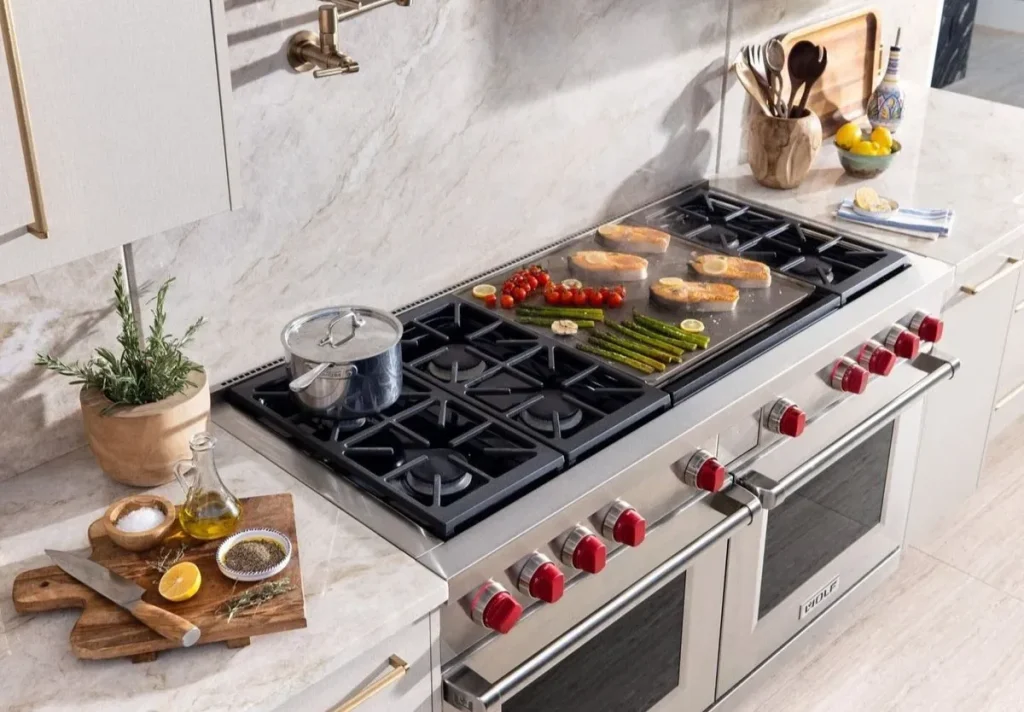
A Wolf range is two appliances in one body: a high-output gas or dual-fuel cooktop on top and a convection oven below. They share a control board but run on independent gas and electrical systems, so a fault in one does not mean a fault in the other.
Wolf’s dual-stacked burners raise the detail level further. Each burner has two flame tiers, a simmer tier and a high-heat tier, that ignite independently. So a single burner acting up can have several causes depending on which tier is affected, and the fix depends on getting that right.
Gas makes accuracy matter more. A misdiagnosed gas fault is a safety issue, not just a delayed repair, so we test spark and gas flow separately before touching a part. The convection oven is calibrated to tight Wolf tolerances, which means a small sensor or fan fault can throw off baking without showing an obvious error. We diagnose the cooktop and the oven as the separate systems they are.
Wolf Range Models We Repair
We service every Wolf range configuration, from dual fuel and all-gas to induction, in 30 to 48 inch widths.
-
Wolf Dual Fuel Range
Gas burners on top paired with an electric convection oven below in 30, 36, and 48 inch widths. It combines precise flame control with even electric baking. We service burner ignition, gas valves, and the oven electronics as separate systems.
-
Wolf Gas Range
All-gas configuration with dual-stacked burners and a gas convection oven in the same width range as the dual fuel line. Common service points are igniters, gas valve assemblies, and oven temperature sensors.
-
Wolf Induction Range
Fully electric range pairing induction cooking zones with a convection oven and no gas components. Service covers induction coils, inverter boards, and touch controls, alongside the same convection electronics as other Wolf ranges.

Common Wolf Range Problems We Diagnose and Fix
Most Wolf range calls come down to a burner, the oven, or the controls. Here is what each symptom usually points to.
Burner Clicking but Not Igniting
On Wolf's dual-stacked burners, each tier ignites on its own, so a burner that clicks without lighting may have a fault isolated to just the simmer or high-heat tier. Usual causes are a clogged port, a weak igniter, or gas not reaching that tier. We test spark and gas flow separately.
Uneven Flame or Low Burner Output
Flames that differ across burners, burn low, or run yellow point to clogged ports, an air-shutter adjustment, or a gas-pressure issue. We clean, adjust, and verify a clean blue burn on both tiers.
Oven Not Reaching or Holding Temperature
Wolf's convection oven is calibrated tightly, so a drifting sensor, a convection fan not cycling, or a weak igniter on gas models shows up quickly in baking. We compare real cavity temperature to the setting first.

Control Panel Not Responding
Gas and electric functions share one board but run independently, so an unresponsive panel does not always mean both have failed. We isolate the board, the wiring, and the control lock before replacing anything.

Oven Door Not Sealing
A door that no longer seals lets heat escape, which throws off baking and makes the oven work harder. Usually a worn gasket or a hinge out of alignment. We reseat or replace the seal and align the hinges.

Self-Clean Cycle Not Completing
A self-clean that stalls or throws a fault is often a failed door lock motor or a temperature sensor the cycle cannot trust at high heat. We test the lock and sensor before running the cycle again.
Burner Clicking but Not Igniting
On Wolf's dual-stacked burners, each tier ignites on its own, so a burner that clicks without lighting may have a fault isolated to just the simmer or high-heat tier. Usual causes are a clogged port, a weak igniter, or gas not reaching that tier. We test spark and gas flow separately.
Uneven Flame or Low Burner Output
Flames that differ across burners, burn low, or run yellow point to clogged ports, an air-shutter adjustment, or a gas-pressure issue. We clean, adjust, and verify a clean blue burn on both tiers.
Oven Not Reaching or Holding Temperature
Wolf's convection oven is calibrated tightly, so a drifting sensor, a convection fan not cycling, or a weak igniter on gas models shows up quickly in baking. We compare real cavity temperature to the setting first.
Control Panel Not Responding
Gas and electric functions share one board but run independently, so an unresponsive panel does not always mean both have failed. We isolate the board, the wiring, and the control lock before replacing anything.
Oven Door Not Sealing
A door that no longer seals lets heat escape, which throws off baking and makes the oven work harder. Usually a worn gasket or a hinge out of alignment. We reseat or replace the seal and align the hinges.
Self-Clean Cycle Not Completing
A self-clean that stalls or throws a fault is often a failed door lock motor or a temperature sensor the cycle cannot trust at high heat. We test the lock and sensor before running the cycle again.
What You Get with Every Bristol Repair

Daily work with high-end brands

Accurate diagnosis before any part is ordered
Upfront pricing: you approve the quote before we begin
12-month warranty on parts, 6 months on labor
Licensed and insured in California

Floors and cabinetry protected throughout the visit
view all questions
Frequently Asked Questions

Have Questions About Your Repair?
Tell us the brand and what the appliance is doing, and a technician will take it from there.
Why is my Wolf range burner clicking but not lighting?
The igniter is sparking, but the burner is not catching, which usually means gas is not reaching that burner, a port is clogged, or the igniter is sparking too weakly to light. Wolf's dual-stacked burners matter here: each burner has a separate simmer tier and high-heat tier that ignite independently, so the fault can sit in just one tier while the other lights fine. We test gas flow and spark separately, and on each tier, before replacing a part.
What are Wolf's dual-stacked burners, and how do they affect a repair?
Wolf's signature burner stacks two rings of flame in one burner: a lower simmer tier for very low, even heat and an upper tier for high-output searing and boiling. Each tier has its own ignition. For a repair, a symptom like a burner that will not simmer or clicks but will not light on low often points to one tier rather than the whole burner. Diagnosing which tier is affected is the difference between a targeted fix and replacing a burner assembly that was mostly fine.
My Wolf oven bakes too hot or too cold. Can it be recalibrated?
Yes. If your Wolf oven runs but bakes consistently hot or cold by a set amount, that is usually a calibration offset rather than a failed part, and we can adjust it. If the temperature instead drifts unpredictably or swings during a bake, that points to a sensor or convection fault, which is a repair rather than a calibration. We measure the actual cavity temperature against the setting to tell the two apart.
Do you repair Wolf gas, dual fuel, and induction ranges?
Yes. We service all three. The cooktop side differs between them. Gas burners and induction zones each need a different diagnosis, while the convection oven electronics are similar across the line. Tell us your model when you book so the right approach and any likely parts are ready before we arrive.
Need Wolf Service?
Our licensed, insured technicians are ready to dispatch to your Orange County home.