Why Orange County’s Hard Water Is One of the Biggest Threats to Your High-End Refrigerator
Your Sub-Zero, Miele, or Thermador refrigerator was engineered to last 20 years. Orange County’s water supply is quietly working against that timeline, and most homeowners don’t realize it until the damage is already done. This isn’t a general warning about hard water. It’s a specific explanation of how the mineral content in OC’s water system attacks the internal components that make built-in refrigerators work, and what that means for repair frequency, part longevity, and operating cost.
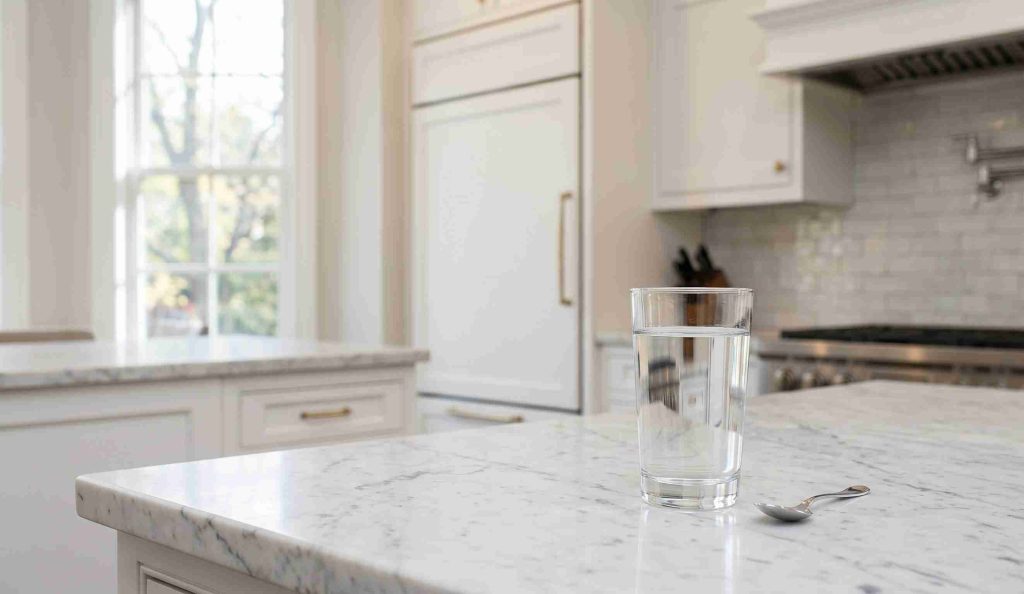
How Hard Is Orange County Water, Really?
Orange County draws water from two primary sources: local groundwater wells and imported surface water from the Colorado River via the Metropolitan Water District. Both sources carry elevated mineral content, primarily calcium and magnesium carbonate.
According to the Orange County Water District, average hardness across the county falls between 10 and 15 grains per gallon (GPG), or roughly 171 to 257 ppm. That places most of Orange County in the “hard” to “very hard” category by Water Quality Association standards, where anything above 10.5 GPG is classified as very hard.
City-level variation is real:
- Irvine surface water: up to 276 to 308 ppm depending on the seasonal blend
- Newport Beach: averages around 205 ppm (approximately 12 GPG)
For context: water above 180 ppm is considered aggressive enough that appliance manufacturers and water treatment specialists recommend preventive measures. Most OC zip codes are above that threshold.
What Mineral Buildup Actually Does Inside a Refrigerator
Hard water damage in refrigerators isn’t dramatic. It’s cumulative. Calcium and magnesium don’t cause a sudden failure. They deposit slowly on wetted surfaces until a component can no longer function within spec. The primary failure points:
Ice Maker Assembly
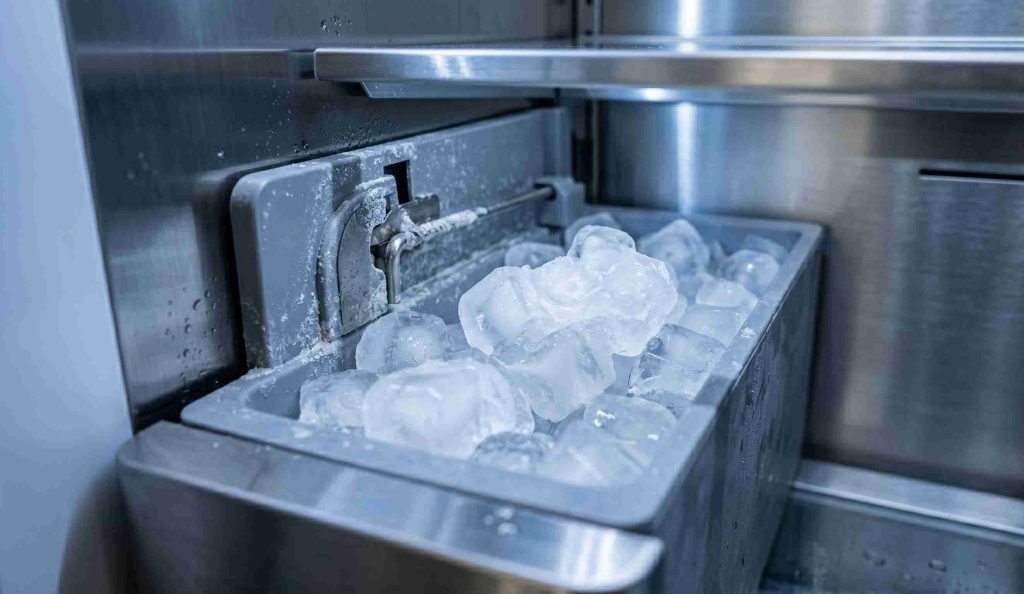
The ice maker is the component most exposed to water flow in any refrigerator. In hard water environments, calcium scale accumulates on the evaporator plate, the surface where water freezes into cubes. As scale builds up, the plate loses thermal efficiency: it takes longer to freeze each batch, and the resulting cubes become cloudy, misshapen, or smaller than spec.
Scale also coats the ejector gears, the mechanism that pushes finished ice out of the mold. In severe cases, the gears bind up and the motor burns out trying to turn against the resistance. In Orange County, where surface water hardness can reach 276 to 308 ppm, this failure pattern tends to appear sooner.
In areas with water hardness above 300 ppm, ice maker ejector mechanisms can show significant wear in as little as 12 to 18 months without preventive descaling.
Water Inlet Valve
Every refrigerator with an ice maker or water dispenser has a water inlet valve, a solenoid-controlled valve that opens to let water in and closes when the cycle is complete. Mineral scale deposits on the valve seat and around the solenoid plunger over time, eventually preventing the valve from closing fully. The result: a refrigerator that drips internally even when the ice maker isn’t cycling, leading to ice block formation in the bin and water pooling at the base.
Replacing an inlet valve on a built-in Sub-Zero or Thermador requires accessing the rear of the unit, which is not a DIY repair in a flush-installed kitchen.
Water Supply Line and Filter Housing
The supply line running from the household connection to the refrigerator’s inlet is usually a narrow-diameter tube. In high-hardness environments, scale accumulates inside the line, progressively reducing water pressure to the ice maker. Low pressure causes underfilled ice molds, producing thin or hollow cubes that stick together in the bin.
Filter housings are affected as well. When filters aren’t replaced on schedule (Sub-Zero recommends every 6 to 12 months depending on usage), the filter media becomes saturated with mineral deposits and stops flowing adequately, compounding the pressure issue.
Dispenser Components (Miele and Built-In Models)
Miele’s built-in refrigerators and cooling units with water dispensers route water through narrow internal channels that are particularly vulnerable to calcification. Partial blockages in these channels reduce flow and, in some configurations, back up enough to create condensation issues inside the cabinet.
Why Built-In Refrigerators Are More Vulnerable Than Freestanding Models
This is a distinction that matters for Orange County homeowners who invested in a high-end kitchen build.
Freestanding refrigerators can be pulled out, inspected, serviced, and moved without disruption to the surrounding space. Built-in models, such as the Sub-Zero 600 Series and Thermador Freedom, are flush-mounted into cabinetry, often with custom panels. Accessing rear components requires either pulling the unit (which risks damaging cabinet surrounds and flooring) or working through limited front access.
This means:
- Hard water damage that would be a simple repair on a freestanding unit becomes a more involved job on a built-in
- Deferred maintenance costs more: a partially scaled inlet valve that would have been a $150 fix at 18 months becomes a $600+ repair at 36 months when the valve fails completely and causes water damage
- Descaling internal components often requires disassembly that isn’t practical for homeowners to perform without risking damage to panel finishes or interior fittings
The OC-Specific Pattern: What We See in Irvine and Newport Beach
Across our service calls in Irvine and Newport Beach, hard water damage follows a recognizable sequence in refrigerators that haven’t had proactive water system maintenance:
12 to 24 months in: Ice quality declines. Cubes become cloudy or small. Ice production slows. Most homeowners attribute this to the filter needing replacement, which is partially correct but not the whole picture.
24 to 48 months in: Ejector gear resistance increases. The ice maker begins cycling without harvesting cleanly. Some units start showing “Service Ice” alerts or stop producing ice entirely.
48+ months in: Inlet valve mineral deposits cause incomplete closure. Water drips into the ice bin between cycles. Ice fuses into solid blocks. In some cases, water escapes the bin and pools beneath the unit.
This progression is not inevitable. It’s a function of water hardness, filter maintenance frequency, and whether the homeowner has any whole-house or point-of-use water treatment in place.
What Actually Helps, and What Doesn’t
Replacing filters on schedule addresses particulate contamination but does not remove dissolved minerals. A standard carbon-block filter, even a genuine OEM filter for Sub-Zero, Miele, or Thermador, is not designed for mineral reduction. It improves taste and removes chlorine. It does not descale your ice maker.
What does help:
- Whole-house water softener: removes calcium and magnesium before water reaches any appliance. Most effective at preventing scale formation.
- Point-of-use reverse osmosis system at the refrigerator connection: produces very low-TDS water, essentially eliminating scale risk. Note that some manufacturers specify minimum water pressure requirements that RO systems must meet.
- Annual professional descaling of the ice maker assembly: removes accumulated scale before it reaches the damage threshold. Extends component life significantly in high-hardness environments like much of Orange County.
What doesn’t help: vinegar poured into the ice maker, generic “descaler tablets” not rated for the specific appliance, or running extra ice cycles to “flush” the system. These approaches either don’t reach the affected surfaces or risk damaging sensitive components.
Common Questions
How do I know if hard water is affecting my refrigerator?
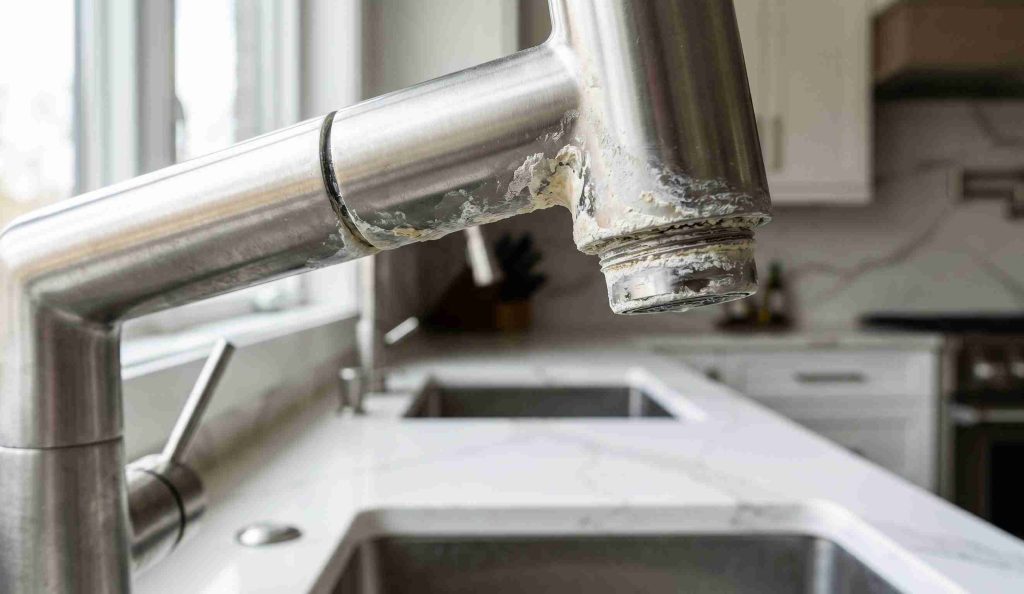
The earliest signs are ice quality changes: smaller cubes, cloudy appearance, or slower production. You may also notice white scale deposits around the water dispenser nozzle. If your filter is current and these symptoms persist, mineral buildup in the ice maker or supply line is the likely cause.
Does brand matter when it comes to hard water resistance?
Not much. All brands using standard water delivery components are affected by hard water. Sub-Zero, Miele, Thermador, and Bosch all use inlet valves and ice maker assemblies that are vulnerable to scale. Some higher-end models use larger-diameter internal water channels, which are slightly less prone to blockage, but none are immune.
Can I descale the ice maker myself?
Partly, yes. Basic ice maker cleaning, such as removing the bin and wiping accessible surfaces, is homeowner-appropriate. Descaling the evaporator plate or supply line on a built-in unit typically is not. The components are difficult to access without partial disassembly, and using the wrong descaling agent can damage rubber seals or internal coatings. A service technician familiar with your specific model can descale properly without risking secondary damage.
How often should I have the ice maker serviced in Orange County?
In homes without a water softener or RO system, annual service is a reasonable baseline given OC water hardness levels. Homes with whole-house softening can extend that interval. If you’re seeing ice quality changes before 12 months, that’s a signal that your water hardness is on the higher end of the OC range and service intervals should be shortened.
Does the 12-month parts warranty cover hard water damage?
No, it does not. Hard water damage is classified as a maintenance issue by manufacturers and is generally not covered under parts or labor warranties. This makes preventive care more valuable, not less: catching scale buildup before it causes component failure is the only reliable way to avoid out-of-pocket repair costs.
Service for Built-In Refrigerators Across Orange County
Bristol Appliance Repair specializes in high-end and built-in refrigerator repair in Irvine, Newport Beach, and 10 more Orange County cities. We work on Sub-Zero, Miele, Thermador, Bosch, Viking, KitchenAid, and GE Monogram refrigeration. If your ice maker is producing less ice, your cubes have changed quality, or you’re seeing water pooling beneath the unit, a diagnostic will determine whether hard water damage is involved and what it will take to correct it. The service call fee is waived when the repair is completed, and every repair comes with a 12-month warranty on OEM parts and 6 months on labor. Call (949) 303-7711 or schedule online.